How to Design Art for 2 Color Screen Print
Getting t-shirts printed is an ideal way to promote your business, organization or event. They are a promotional item that people can actually employ, and they have the added bonus of being an advertisement for yous. In this post, Adobe Illustrator volition be used to create a three-colour screen print using a fictional company logo, and have it ready upwards to allow a screen printer to hands print the color separations that create the separate screens for each colour print.
Although some printers adopt to create their own separations, information technology'southward always practiced to understand the process. Be sure to communicate with your printer equally they will specify their requirements, and will often give you tips for avoiding potential issues in the procedure.
Further Reading on SmashingMag:
- forty Splendid Adobe Illustrator Tutorials
- An In-Depth Study Of Symbols In Illustrator CS5
- 35 Excellent Adobe Illustrator Video Tutorials
- Inspiring Illustrator Artworks By Artists Effectually The World
Printing Techniques
As the t-shirt is going to be printed in 3 colors, nosotros have to create separate artwork for each layer of color. Each of these layers interact with each other to class a complete image.
More subsequently jump! Keep reading below ↓

Examples of Trap, Knockout and Overprint
In that location are 3 artwork techniques commonly used for this type of printing: Trap, Knockout and Overprint. The Trap technique is when the bottom color "bleeds" nether the top color, ensuring no gaps are left from inaccurate printing of the second color (when the and then-called "registration" between the colors is "off").
Screen printing is not e'er an verbal press technique, peculiarly when printing onto fabric surfaces; for this reason the Knockout technique is rarely used, as it relies on printing a colour precisely in a gap left on the bottom color. The 3rd technique, Overprint, is the easiest to attain as the summit color prints directly on top of the bottom color; often this produces a new color, as the top ink color is not e'er opaque.
Preparing Your Artwork File
1. Create Layers for Each Color
The almost reliable style to produce artwork for screen printing is to manually set up it in Adobe Illustrator. Each of the 3 colors is going to form a separate artwork in a separate layer, using elements from the principal prototype for each colour. Using Layers does not affect how your artwork is output by your screen printer; it simply makes it easier for you to work on.
Opening the vector artwork in Illustrator presents the graphic in Layer 1. Select the drop-downwardly carte du jour in the Layers window and select Duplicate Layer twice, to produce 3 layers of the aforementioned graphic; proper name the 3 layers after their corresponding colors, as this will aid foreclose confusion later on. Ensure the order of the colors is right: the lesser layer is White; the next colour layer is Orange; and the acme layer is the Dark Red, which will exist printed concluding, on elevation of the other colors.

Layers existence created and renamed
2. Create a Temporary Background Colour Layer
At this stage — because the artwork is being prepared to exist printed on a nighttime t-shirt — create a fourth layer for a temporary groundwork color and name information technology Temporary Groundwork. A rectangle is drawn the total size of the art board, and given a nighttime color; this layer volition exist removed later on in the process. Elevate the layer to the bottom of the layers, and Lock it. Each color of your artwork produces a separate screen, and the society in which the colors are printed is usually from the lightest to the darkest color.

A Temporary Background layer is created
3. Remove Excess Objects From the Layer
The first layer to be worked on, is the lesser White layer. Hibernate the Orange and Dark Cherry layers by clicking the Eye icon next to their layers, and make certain the White layer is selected in the Layers window past clicking on its proper name. As the artwork layer was duplicated in full, all the objects of the graphic are on this layer; some objects must exist removed, leaving the shapes that form the white outline of the rocket, the text, and the orange fan shapes used in the background.
4. Outline All Strokes
The rocket outline is a solid shape and then no further work is needed on the rocket, just the white outline of the text is a thick stroke applied to the text shapes; working with strokes tin be unpredictable, so it'southward all-time to create outlines from the stroke by selecting the text and choosing Object ? Path ? Outline Stroke. This ensures consistency if the artwork needs to be resized (Strokes can often be pushed out of proportion when resized with the Scale tool).

Outline Stroke on text objects
5. Create and Apply a Custom Spot Color
Select all the objects in this layer and utilise a low-cal color to each of them. Avert using absolute white, as you won't be able to come across the objects when checking Separations later. Apply a colour of 20% Yellow to the objects and so, in the Swatches window, select New Swatch from the drop-down card. Proper noun the swatch "White base" and choose Spot Color from the Color Type carte. Fifty-fifty though it's set to 20% yellow, it will output as a solid color, titled "White base."
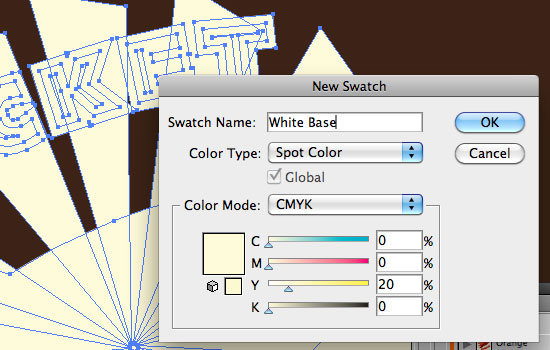
Creating a new Spot Colour Swatch
The swatch now will be in the Swatches window and in that location will be a dot in the corner to denote a Spot colour. The Spot color should be applied to all the objects in the White layer.

Spot colour in the Swatches window; note the dot in the corner of the selected swatch
6. Manually Creating Trap
Hibernate the White layer and select the Orange layer. Remove any objects that are not relevant to this color layer, such as the white background objects and the dark red objects. The remaining objects are going to be printed in orange underneath the night red. Due to the inaccurate nature of screen printing, you tin't simply knock out the shape of the orange elements from the summit red color and precisely print over the orange; yous have to create Trap between the two colors, to allow for slight "wobbles" in color registration.

Potential mis-registration of two colours, seen between orange and dark red
Select an Orangish object and choose Object ? Path ? Start Path. Get-go the path past 1 mm to make the object larger in shape. Oftentimes printers specify how much Trap they require, similar to how they might specify Bleed. On this artwork, the white background outlines the colour objects, but if you wanted the white to be printed directly behind the colors, without a white outline, you could starting time the path of the White objects by a minus effigy (for example -1mm).

Left: Earlier offsetting path past 1mm. Correct: After offsetting path to create Trap
7. Deciding on a Spot Color
Once Trap is created for all the orangish objects, select all the objects and create a Spot color from the Swatches menu. If y'all are specifying a Pantone color, proper noun the Spot color with the Pantone Matching System (PMS) reference; otherwise, proper name it descriptively, in this case, Orange.
Carry in mind that it is frequently the case that printers have inks that they proceed in stock and you could save some cost by using an indefinite "orange" rather than specifying a Pantone colour, such equally Pantone 179. Additional charges tin can exist placed on inks that have to be bought or mixed for a specific project (specially with smaller impress quantities). Talk to your printer and see what your options are, as they might supply you with ink color samples to choose from. Samples are definitely worth paying for; they requite you a much better idea of color than swatches do.

Pantone Colors can be plant under Window ? Swatch Libraries ? Colour Books
8. Knocking Out for the Trap Beneath
Once the Orange Spot color is applied to the Orange layer, hide the Orange layer and testify the top layer, the Night Red layer. Again, remove unneeded objects such as the white groundwork elements, but leave the Orange highlight objects.

Artwork with white base color removed
For each object with an Orange highlight, employ the Pathfinder tools (Window ? Pathfinder) to Exclude the highlight color, effectively creating a void in the object shapes. This is Knockout; but as we created Trap on the Orangish layer objects, we won't get whatever registration problems. When using the Exclude tool, the object takes the colour of the top object which is excluded. Change the color back to the original Dark Red using the Eyedropper tool on one of the other other objects.

The Exclude tool (circled in green) is excellent for removing shapes from within objects
If the artwork was not being separate into layers, the Knockout and Trap could be created automatically using overprinted strokes. This does save fourth dimension but allows less control on the final impress and is more than prone to errors (such every bit forgetting to add Trap to objects).
9. Trap is Non Always Necessary
There was no Trap created for the Dark Red text on the rocket, as it will be Overprinted on to the Orange. In situations where the printing area is small, information technology's best to not create Trap as the area left open below the Overprinting color ordinarily ends upwards beingness insignificant.

For smaller text and objects, the Trap is also small-scale, so the object is Overprinted instead
Again, select all the Dark Red elements and create a new spot color. If y'all are using not-specific colors, always supply the printer with a printed proof to allow them to friction match the color equally closely every bit possible. This printed proof often helps the printer identify issues with your artwork earlier they move onto the expensive phase of producing moving-picture show for creating the screens.
x. Checking Your Separations
Once you accept completed the last pace, y'all are now ready to prepare your artwork to send to the screen printer. Outset, you accept to set the Orangish and Dark Red colors to overprint. Select Windows ? Separations Preview. From the window that opens, first check the Overprint Preview box and and then hide the CMYK separations past clicking the centre icon beside CMYK. The temporary dark background should disappear.

Separations Preview
Check your separations past hiding each color, one at a fourth dimension, starting with the Night Crimson. You volition notice that the Trap yous created earlier is gone and the white background is only an outline. This happens because the Orange and Dark Red are not set to overprint the colors below them.

Separation of the three colors earlier Overprint is set up
11. Setting Objects to Overprint
Get-go, uncheck the Overprint Preview box in the Separations Preview window. Then, hide all the layers except the Orangish layer (you tin also delete the Temporary Background layer; it's no longer needed). Select Window ? Attributes. With all the Orange objects selected, check the Overprint Fill up box in the Attributes window. Practice the aforementioned with the Nighttime Crimson layer, ensuring all the Dark Red objects are selected when y'all check the Overprint Fill up box in the Attributes window.

Setting Overprint Fill on two colors
12. Recheck Your Separations
Go back to the Separations Preview window and check the Overprint Preview box. Yous should now see a colour variation on the artwork, where you lot created Trap earlier. If you too wait at the White layer, you'll see that the whole shape is left intact, due to the Orangish and Dark Red fix to overprint.

Left: Trap can be seen by darkened surface area around Orange. Right: White base returns to a solid shape (shown with temporary background, for illustrative purposes)
13. Ensure In that location are No CMYK Objects in the Artwork
One thing you accept to ensure before saving your file to send to the screen printer, is that in that location are no CMYK elements in your document. This can be checked easily by choosing File ? Impress. Select your printer as Adobe Postscript File and click the Output option on the left side. Select Mode as Separations (Host-Based). On the list of colors below, if the printer icons shows side by side to any of the process colors (Process Cyan, Process Magenta, Process Yellow or Process Black), you take elements in your artwork which are set in CMYK colors.

Checking for CMYK objects using the Print dialog box
fourteen. Finish Upward and Send It Off
Once you are sure your Spot colors volition divide equally you lot expect them to, save your file every bit PDF and send information technology along with either a JPEG or printed proof. Sometimes printers request the original Illustrator file, in case they demand to brand alterations themselves. A skilful printer will check your files, and permit you know if at that place's an issue earlier the procedure of creating screens begins.
Final Note
There are many culling techniques to gear up your artwork for screenprinting; today's post concentrates on more transmission techniques, for demonstration purposes and likewise for reliability. Your artwork will probably be output on a unlike hardware and software configuration to yours; the more circuitous your artwork, the greater the possibility of errors during output.
There are ii areas you must pay close attention to: make certain you are only using spot colors, and ensure all pieces of your artwork get output by the screen printer as you expect it to.
Often, a stray object set to a CMYK value is left somewhere on your artwork, which causes one of ii issues: either the screen printer outputs an extra color(s) to pic (with which the screens are created), possibly incurring actress cost; or the screen printer only outputs the specified Spot colors, and part of your artwork goes missing on the last print. Use the Separations Preview window to cheque the different layers of your artwork, making certain colors overprint where they should and that all pieces of your artwork are nowadays and correct.
Information technology'southward of import to strike upwardly a good relationship with your screen printer, whether they are a local company or i you establish on the Web. They can give you vital communication, and could potentially spot mistakes earlier the screens are made or any t-shirts are printed. Also, if they're a local business, try to get a bout of their print shop; screen printing is a great process to observe, and beingness familiar with the procedure is a great help when making design and preparation decisions.
Further Resources
- Using Separations Preview (Adobe tutorial, with an alternative trapping method toward the terminate)
- How To Create Your Own Colour Separations in Adobe Illustrator
- Gig Posters Process (t-shirt printing procedure photos)
- Screen Printing Overview (YouTube video)
- Trapping Tips For Improving the Quality of Print Jobs
(ik) (rs)
Source: https://www.smashingmagazine.com/2010/12/preparing-artwork-for-screen-printing-in-adobe-illustrator/
0 Response to "How to Design Art for 2 Color Screen Print"
Post a Comment