How to Improve Reading Comprehension 3rd Grade
Read At Home Everyday
Reading at home independently or aloud for enjoyment is the unmarried all-time daily routine to assistance strengthen your child'southward agreement of stories. Asking simple questions about the characters and talking about all-time parts of a volume gets your child thinking about the story and making connections to their own life.
Inquire Open-ended Questions
Its piece of cake to fall into the trap of always asking simple, straight forward questions that elicit one-word answers about your child's reading. Of course you desire to make certain they're understanding what they read, so you ask questions such as "Who is the principal character?"
Endeavor asking a question that stretches your kid'south thinking and allows them to explain their feelings. "Did you agree with what the grapheme did? What would you accept done?"
This taps right into higher level critical thinking skills, deepening their comprehension while giving y'all a window into their thoughts.
G-W-L
A Thousand-W-Fifty chart is a popular method for teachers to claw their students and get them thinking right away nearly a story they're nigh to read.
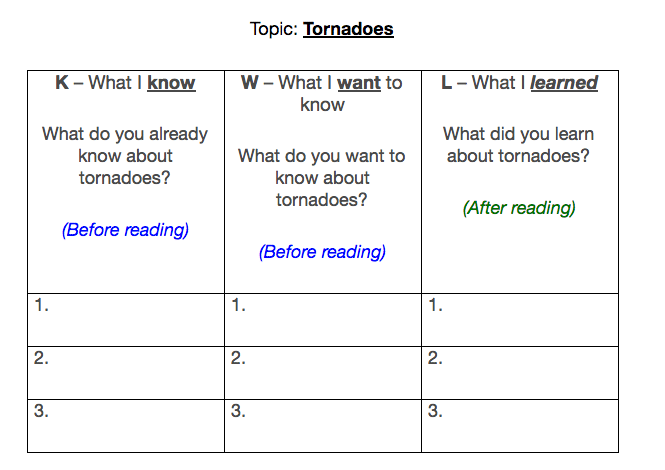
This is all-time used for nonfiction reading, or books most facts. You don't have to write this all downwards, these questions can be used when talking with your child equally they read. It's quick and easy, but will become your child diving into the topic they're learning.
Proceed information technology Light
Conversations about books should be fun. Quizzing a child for right answers after reading their favorite volume tin can suck the joy out of the reading feel. Instead, attempt to ask questions from a place of curiously and wanting to know what your child thinks. This makes them feel that their opinions and thoughts matter.
Use the Five Finger Strategy
Later reading a story use your hand to help yous remember the most important elements of the story. This technique can be used for people ages 4 to 94.
- Characters – Who was in the story?
- Setting – Where did the story take identify?
- Events – What happened in the story?
- End – How did the story terminate?
- Your Accept – What was your favorite function?
CLICK HERE FOR THE V FINGER RETELL PRINTABLE
Try the 5 W's to Larn Summarizing
Second Graders learn the skill of "summarizing," or retelling the main points of what they take read. Enquire your kid these questions to further help them think what they take just read.
- Who – Who are the characters or people?
- What – What happened?
- Where – Where did it take place?
- When – When did it happen?
- Why – Why did the story stop the way information technology did?
Process It
When reading with your child, a great technique is to break afterward a few pages and check in to see if your child is truly grasping what they are reading. Asking open-ended questions allows them to explain their thinking. If what they tell you does not yard atch the story, you tin can help redirect them back on rails:
You: "Helen Keller's instructor wrote the word "Westward-A-T-E-R" into the palm of her paw as water was flowing onto her when she was 7 years onetime. Why did she do this?"
Your child: "I don't know….maybe it was to tickle her."
You lot: "Helen could not see or hear. What do you think Helen was learning when her instructor did this?"
three Seconds of Wait Time
Allow your child enough undisturbed "recall time" to process what is happening. If you enquire them a question about the story, let them look at the pages and take a few moments to think, at least three seconds. Nosotros typically only wait one second before jumping in with the answer. Providing answers likewise quickly takes away a child's "thinking time", robbing them of the opportunity to fo rm conclusions on their ain.
Bear witness Bear witness
As your immature reader matures, they can demonstrate their understanding in more sophisticated means. When asking them questions from the story, ask them prove their answers by showing you the pages and words that depict the outcome.
Use Sticky Notes to Show Your Thinking
A great manner for your child to call back and internalize what they read is by using viscid notes. Have your child write these symbols on a sticky notation and place them next to a line in a book to show their thinking.
LOL = funny part
? = confusing part
= favorite part
* = of import part
Tame the Testing Animal
Your child will be required to take their showtime standardized reading test at the end of the schoolhouse year. The test volition comprise l multiple option questions.
To meet sample exam questions, click here .
Information technology is helpful for parents to look through these questions and get a sense for how your child volition be tested. Attempt practicing exam questions with your child, but go along it short. In one case a week read a sample passage with your child and have fun answering 2-iii questions together. Make information technology into a game for them to win prizes, similar picking a flick for weekend. The purpose of these sessions is to (one) heave your child's conviction, (2) assistance parents give their kid tips for answering questions, and (3) to diffuse the anxiety from testing through curt practice sessions.
Different Ways to Read
Books are the best way to betrayal children to new vocabulary, stories and higher level thinking skills. Only reading on their own is not the unmarried style to admission stories. Read alouds and sound books offer the same benefits and permit children savour a great book. The NC Kids Digital Library offers hundreds of picture read alouds that let your child hear stories and build their reading skills.
Source: https://www.homereadinghelper.org/3rd-grade-reading-skills-reading-comprehension/
0 Response to "How to Improve Reading Comprehension 3rd Grade"
Post a Comment